Division 293 Tax is an additional tax imposed by the Australian government on high-income earners in addition to the normal taxes they pay. Division 293 Tax is calculated separately from income tax and is specifically applied to concessional superannuation contributions that exceed the concessional contributions cap or to an individual’s income for surcharge purposes that exceeds the Division 293 threshold (currently at $250,000).
Individuals should be aware of several key aspects regarding Division 293 Tax:
Thresholds: Division 293 Tax applies to individuals with combined income and concessional superannuation contributions exceeding $250,000 in a financial year. It is important to note this tax threshold can change over time due to legislative updates or government decisions.
Concessional Contributions Cap: Concessional contributions include employer contributions (such as employer superannuation guarantee contributions and salary sacrifice contributions) and personal contributions claimed as a tax deduction. It is important for individuals to monitor their concessional contributions to avoid exceeding the cap.
Currently, the Concessional Contribution Cap sits at $32,500 as from 1 July 2026 through indexation. A high contribution cap does not increase the Division 293 Tax threshold.
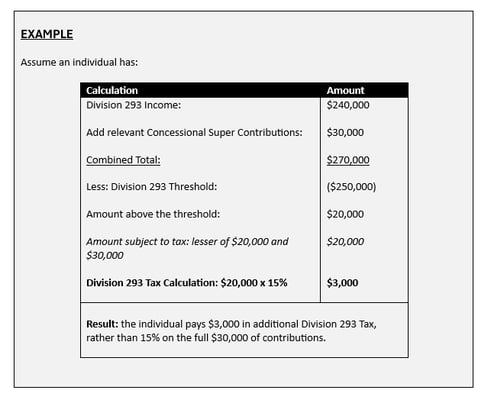
Calculations: Division 293 Tax is calculated as 15% of the lesser of:
- The individual’s concessional superannuation contributions less any excess concessional contributions
- The amount by which the individual’s income for surcharge purposes exceeds the Division 293 threshold.
Higher Compulsory Employer Contributions: the general Superannuation Guarantee Rate increased to 12% in the 25/26 Financial Year and has continued into the current financial year. The rate is also set to be fixed at 12% from 1 July 2027 onwards.
It is important to highlight that high employer contributions can bring you closer to the Division 293 threshold, depending on your remuneration arrangements.
Payday Super: From 1 July 2026, employers must pay Super Guarantee each payday. Check contribution timing and actual fund receipts when reviewing your annual position. This change impacts employer payment arrangements, not the Division 293 rate or threshold.
Impact on Retirement Savings: Division 293 Tax reduces the tax concession individuals receive on their superannuation contributions. High income earners may need to reassess their retirement savings strategies to account for the reduced tax benefit.
Planning Opportunities: While Division 293 Tax increases the tax burden on high-income earners’ superannuation contributions, there may be planning opportunities to minimise the impact, such as contribution timing, alternative tax-efficient investment strategies and consider non-concessional contributions.
Reporting and Compliance: Individuals subject to Division 293 tax must ensure accurate reporting of income and superannuation contributions and plan for additional tax payments.
Paying Division 293 Tax in Australia typically involves the following:
Notice from the Australian Tax Office (ATO)
If you are subject to Division 293 Tax, the ATO will notify you of your tax liability. This notice will outline the amount for Division 293 Tax owed and provided instructions on how to pay this.
Review the Notice
Carefully review the notice from the ATO to ensure its accuracy. Check that the calculated tax amount aligns with your income and superannuation contributions made for the relevant Financial Year.
How to Pay:
Option 1 |
Option 2 |
|
With your own money (via EFT, BPAY, Credit Card, Direct Debit or payment by mail). |
By releasing money from Super, by completing an election form via MyGov (quickest way) or a paper form. Most Defined Benefit Funds are not able to release amounts to you, check with your fund before completing the election form. Once the ATO receive and process the election form, they will send an "Authority to Release Statement" to you with instructions on how to make payment. |
Keep Records
After making the payment, retain records of the transaction as it may be required for future verification.
Final Thoughts
Overall, Division 293 Tax introduces considerations for high-income earners regarding their retirement savings, tax planning and overall financial management. We recommend that you seek advice from us or your financial advisers to help you understand the implications of Division 293 Tax and implement appropriate strategies to help you manage your tax obligations and retirement savings.
For More Information
For more information on the implications of Division 293 Tax, how to implement appropriate strategies or an initial consultation, please contact the Archer Gowland Redshaw team on (07) 3002 2699 | info@agredshaw.com.au.